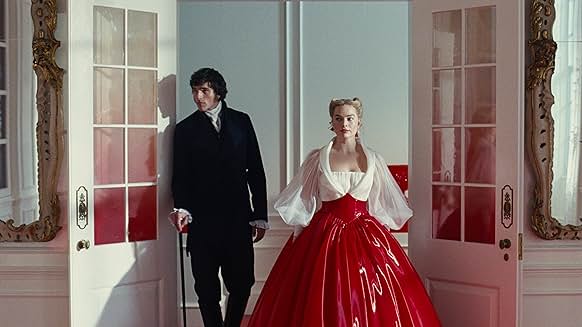
"Wuthering Heights" (2026)
First screened and reviewed in February 2026
Director: Emerald Fennell. Cast: Margot Robbie, Jacob Elordi, Hong Chau, Shazad Latif, Alison Oliver, Martin Clunes, Charlotte Mellington, Owen Cooper, Vy Nguyen, Ewan Mitchell, Amy Morgan, Paul Rhys. Screenplay: Emerald Fennell (based on the novel by Emily Brontë). In Brief:
Why not stage the dream production of Brontë's brattiest fan? Plenty of its wildest swings connect. Oliver's A+.
VOR:④
I get why many viewers balk. Sometimes I did, too. But we need more singular, even heretical adaptations, and the craft is easy to underestimate.
Mar-got Rah-ah-ah!!
Jacob Oh-la-la!!
Brah-brah-ön-tah-tah!!
Want your bad romance.
It's hilarious that they're marketing this scare-quoted "Wuthering Heights" with "Greatest Love Story of All Time" rhetoric when the precise strength of Emerald Fennell's strange, sometimes dodgy, frequently startling, increasingly persuasive approach is that she takes the piss out of that fatuous slogan. This is the least gunning-for-posterity WH I've ever seen, and the least romantically moors-driven, though when Fennell wants landscapes or atmosphere to register, they mostly do. The movie takes almost every possible chance to stress the sheer, petulant brattishness that is a core element of Cathy and Heathcliff's bond. They are that couple in high school who were together all four years, united in lust and mutual fascination, but who seemed to be breaking up at their lockers again every single time you spotted them, stomping around the linoleum hallways, maybe kicking a trash can.
I'm really impressed that Fennell is able to sound that note so aggressively in these characterizations but still extract some pathos, some humor, and some sympathy from Cathy's and Heathcliff's tempestuous interactions—which are nuanced when Fennell wants them to be and bravely hyperbolic when she doesn't. Some people just cannot stop devoting their entire lives to someone who has proved to upset and demean them as much as they've gratified or understood them. They suck to be around but their stories can be worth our time. Fennell's take is more about folly than tragedy, but that doesn't mean it's never moving, due in large part to Robbie's and Elordi's resourcefulness.
This Wuthering Heights, the sixth screen adaptation I've seen, is also the first one where Edgar, Nelly, Isabella, and Cathy's father all popped as characters and had their own gravity fields, instead of just seeming like wan or plot-mandated supernumeraries. Alison Oliver's Isabella is an especially brilliant comic creation who turns out to be capable of evolving into something else.
I see-sawed on some of the craftsmanship and directorial shaping. The editing is often very crafty and mercilessly abrupt; the razor-cut montage of Cathy making a new life with the Lintons, begrudgingly but also merrily, is one of several wonders. The best of the costumes and set designs compensate more than amply for what occasionally falls flat in those areas. The reverse is true of the cinematography, though: Linus Sandgren makes too many familiar Linus Sandgren mistakes with shadow and contrast and tint and framing, even though he has his moments. The Charli xcx songs don't add a lot, I'm sorry to say, and it's unclear how committed to them Fennell ultimately felt, though Charli's spirit pervades the whole experience.
I'm still deciding what to think about how important tackiness is to Fennell's aesthetic and maybe even her worldview. Sometimes her images, her plot beats, or her management of tone just feel naff and coarse. The first sounds we hear in Wuthering Heights and the shock cut to their source make no bones, as it were, about Fennell's willingness to go low where most Brontë adaptations, or most manor house dramas, or many #MeToo-era feminist fables would go high. But especially in this movie and in Saltburn, Fennell seems very comfortable with tackiness and even genuinely interested in it—one enduring register of human foible, passion, and interaction, as ripe for exploration as happiness or cruelty or ardor or shame or mendacity, all of which get a full airing in this film as well. She has enough to say and show about the most garish and puerile sides of human behavior and decision-making and she brings enough stylistic flair to the inquiry that I'm willing to follow her pretty far down the boldly colored, fluid-stained paths she lays down. She's like the Tonya Harding of movie directors, and we often forget that Tonya Harding was a world-class athlete, whatever else you could say about her.
There's also a pitiless, violent quality to how Fennell sees her people, their worlds, and our world that I find kind of rare and exciting. She sustains that POV, sometimes past a breaking point, but often with a resonant, rewarding, anything-might-happen tension—and she does so without just belittling or punishing her characters or suggesting she is superior to them. In fact, she seems sort of charmed by their venality, enough to dabble in some of her own, and she's disarmingly attuned to some vulnerabilities in the people she portrays, even or especially when they're working hard to conceal them. Grade:B
(I originally wrote this piece on Letterboxd, where you can comment.)