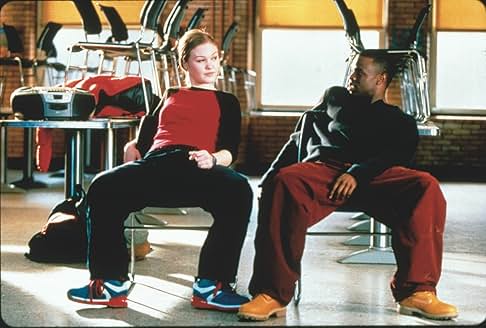
Save the Last Dance
First screened and reviewed in March 2002 / Most recently screened and reviewed in January 2026
Director: Thomas Carter. Cast: Julia Stiles, Sean Patrick Thomas, Kerry Washington, Fredro Starr, Bianca Lawson, Terry Kinney, Jennifer Anglin, Vince Green, Garland Whitt, Elisabeth Oas, Dorothy Martin, Ora Jones, Felicia Fields, Tab Baker. Screenplay: Duane Adler and Cheryl Edwards (based on a story by Duane Adler). In Brief:(2026)
Dubious dynamics in the script, but as expressed on screen it has charisma. Can't decide if it's a dance film?
VOR:③
Without being "important" (or great), this movie left noteworthy fingerprints on culture : musically, dance-wise, and even commercially.
It's pretty wild to revisit a movie 25 years after you saw it, having long ago moved to the city where the film takes place. I'd never even been to Chicago when Save the Last Dance came out. Plus ça change: there's a moment on one of Julia Stiles's and Sean Patrick Thomas's walking dates where you can not only see my apartment building but clearly spot the window of the room where I was watching the DVD. A good friend and repeated guest in this apartment popped up in a single early scene as the unspecified principal or guidance counselor or Shell-Shocked White Girl Triage Liaison who walks Julia to her first class at her new South Side high school.
The script has the uneven quality of a lot of Y2K-era MTV Films productions, as if producer interference and/or creative and logistical chaos were constants. Summarizing it churlishly would be easy: Save the Last Dance sprints right past "All black people can dance" in pursuit of "All black people will spontaneously offer you, a tremulous white person, unsolicited, unmotivated, and warm-hearted lessons in choreography," whether of actual dance moves or of how to navigate a majority-black school, majority-black club, and majority-black social world. Also, you can get into Juilliard even if you literally fall down in both of your two auditions, a full year apart, and you force the judges to wait during the second one while your boyfriend rushes the stage to prop you up, even though he's having a way worse/crazier/sadder day than you are.
Also, while Save the Last Dance comes alive in different ways when people are dancing, whether in perfectly scored 2001 DJ sets or in patently improv'd coach-student passages where Derek tutors Sara and/or Thomas tutors Stiles in hip-hop movement and swagger, there's a lot less of this in the movie than you might expect (especially with MTV as the production company). Much of what we do get is crammed into montages where we wish we could linger. When we are allowed to savor the dancing, Stiles takes it seriously and gives it her all, but let's just say a white body double or two hopefully got paid well (and a bunch of black background players hopefully got paid at all).
But Save the Last Dance remains appealing, despite its strangely proportioned plot elements and other shortcomings. It never purports to be more than it is but also doesn't look down on what it's designed to be. Pop conviction is a real thing. Director Thomas Carter, a multiple Emmy winner for actor-driven shows, gets the best out of Stiles's combo of industriousness and chill, out of newcomer Kerry Washington's bright and seductive charisma, and especially out of Sean Patrick Thomas, who holds the camera with the confidence of a natural and who ably grounds and distills a character who, as written, presents a lot of difficult-to-connect dots.
It's also easy to sense, whether or not it's true, that Save the Last Dance had more grit and different levels of authenticity at earlier moments in the writing process, as different relations of center to margin almost certainly got tested out (or corporately imposed). Hopefully Derek got more scenes on his own, and more in which his complicated allergy and loyalty to his doomed, wayward friend Malakai got further explored. I bet there were a few more geysers of gut-check honesty about race and class, as when Washington's Chenille drops the scales from Sara's eyes in a pediatric clinic and insists that her friend recognize why the white arriv&233;e poaching the high school's most desirable and upwardly mobile black man prompts a lot of affront, even from people who like Sara. I wonder if Duane Adler and Cheryl Edwards, the credited screenwriters, ever allowed Chenille to confront Derek, her brother, on these same grounds. But it's to the movie's credit that the clinic scene survived.
I also appreciate that as directed, if not necessarily as scripted, there's less hysteria or sensationalism in Save the Last Dance than in other, similar films around youth sexuality or teen pregnancy or drugs. I wouldn't by any means describe Save the Last Dance as cliché-free, but the actors and director infuse the broad outlines with, if not authenticity, at least some human texture. Several scenes work, and the key characters pop. The routine is a little janky on the whole, but the filmmakers put their back into it. Grade:C+
(I originally wrote this capsule on Letterboxd, where you can comment if you like.)