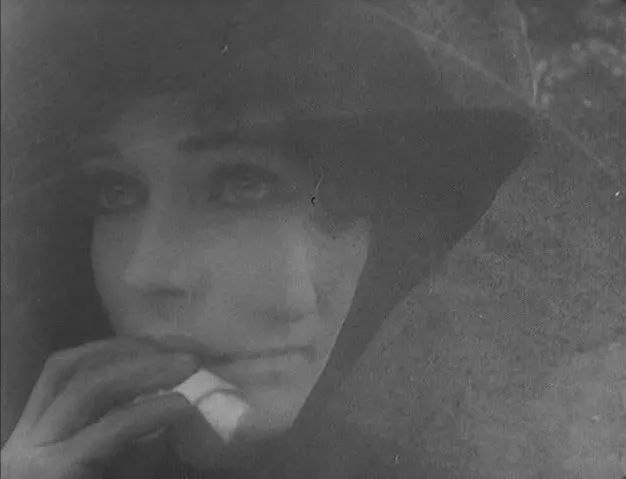
Ménilmontant
First screened and reviewed in January 2026
Director: Dimitri Kirsanoff. Nadia Sibirskaïa, Yolande Beaulieu, Guy Belmont, Jean Pasquier, M. Ardouin, Maurice Ronsard. Screenplay: Dimitri Kirsanoff. In Brief:
Has a deserved reputation as one of the peak achievements of silent cinema. A major feat of style and of storytelling.
VOR:⑤
Somehow a pinnacle of French naturalism and of Russian-style montage. The narrative is potent and themes clear despite all the fracture and ambiguity.
Is the axe-murder that launches Ménilmontant the first one in movie history? The mere fact of that sequence took me by surprise, the kinetic montage and no-holds-barred brutality of it even more so. But that was just the first of many shocks in this silent, staggering, 38-minute mind-blower from 1926, which combines the electrifying formal severity of that decade's Russian innovators with the heightened poetry and the gorgeously grotty naturalism of French writers and filmmakers from the same general period.
I'm throwing reference points at you, but this is not one of those movies you can only appreciate as a contextualized museum piece. This film is fierce: a towering yet delicate audiovisual experience with a wide range of emotional wallops, even as I wouldn't call a single beat or technique "overdone." Its dissolve transitions and expertly composed double-exposures yield some instantly indelible images, though their diaphanous qualities stand in rich tension with the brutality of the movie's rhythms, its montage, and its story. This is Inland Empire in miniature, and 80 years earlier: an archetypal movie about a Woman in Trouble (two, in fact), but also a film that seems to be having a nightmare about itself, or a nightmare that seems to be making a film about itself.
I'd advocate watching Ménilmontant as a blank slate, and doing so immediately, but if you want to know, the story mostly concerns two orphaned sisters in rural France whose intimacy curdles over time into alienation, for personal reasons but also for more socially dictated, patriarchal ones. The division sharpens when one ventures into Paris (and specifically the titular, working-class neighborhood) and runs across a handsome suitor with a leering, Conrad Veidt-ish aura. You can imagine how this goes, but I couldn't imagine how deftly Russian-born, France-based director Dimitri Kirsanoff depicts their first assignation. The lead actress, Nadia Sibirskaïa, also Kirsanoff's wife, hesitates in this obvious roué's doorway with such a long, heavy pause that feels more lifelike than cinematic, and with the kind of subtle but unmissable psychological nuance that I almost never see in silent cinema. Once the apartment is fatefully entered, the room is a precise feat of realist set design: instantly, parabolically predictive of what will happen there, but with such realistic detailing that, once again, the dreamlike trance of the film feels grounded in terrestrial, all-too-common circumstances.
I'm feeling flooded by a reluctance to tell you anything more (and there is more, despite the movie's brevity) or to seek the right phrasings for a movie whose paramount glory is its utter lack of any need for verbal language, or for the predominating film language of its era, or any era. The movie has clear roots in stage melodrama, in opera, in painting, and in multiple traditions of novel-writing but it's irreducibly cinematic. Just watch it, already!
Two codas, though. First, I was surprised after watching to learn from the internet that Pauline Kael, late in her life, named Ménilmontant as her favorite of all time—not because I can't understand the sentiment but because I wouldn't necessarily expect it from her. Second, I was even more surprised after watching to discover from within myself that I now believe in reincarnation. It's just obvious to me that Dimitri Kirsanoff was later reborn as Lynne Ramsay. I was equally certain that Nadia Sibirskaïa was reborn as Marion Cotillard, but the historical dates don't line up, so I guess I also believe in spirit possession, specifically on the set of The Immigrant. Grade:A
(I posted this review on Letterboxd, where you can comment.)