Escape from New York
First screened in December 2025
Director: John Carpenter. Cast: Kurt Russell, Lee Van Cleef, Harry Dean Stanton, Adrienne Barbeau, Ernest Borgnine, Isaac Hayes, Donald Pleasence, Frank Doubleday, Tom Atkins, Charles Cyphers, John Cothran. Screenplay: John Carpenter and Nick Castle. In Brief:
Pulse-pounding premise largely squandered by flat, sluggish execution. A better film was so easily graspable.
VOR:③
Remains a cultural touchstone for lots of people, filmmakers included. I see what it's interesting. Still dwarfed by contemporaneous feats.
After spending all week with Kleber Mendonça Filho's body of work and evangelizing for those films yesterday in Chicago (67 new and re-pledged converts on a Saturday morning!), I thought I'd dip into Mendonça's own church of preference, which is the cinema of John Carpenter—overtly and implicitly cited across Mendonça's films and still being re-platformed in a Criterion Channel retrospective that ends this month. Up to now, I'd only seen Halloween and The Thing, both of which were gripping and sinister in different ways than I'd expected, and Starman and The Fog, both of which left me feeling pretty fleeced. The jury in my one-man principality was still out, as I still hadn't reached some of the consensus milestones in his career.
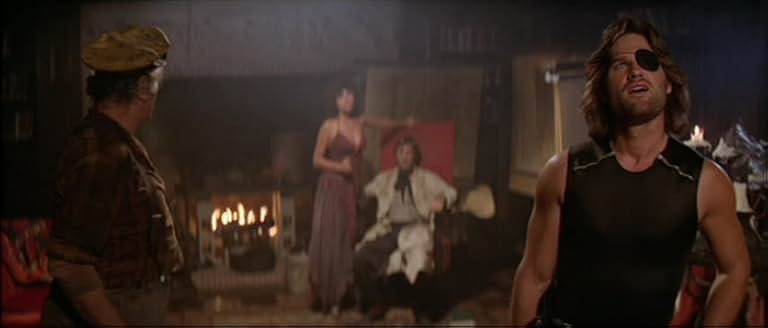
Like many experiences of attending church with a friend, this was interesting and illuminating without coming close to a conversion experience. Escape from New York was not the rip-snorting action thriller I'd assumed, and I can appreciate the slow-crawl experiment: The Dirty Dozen at half-speed. But for me, the film never maximized the potential in that counter-intuitive approach. Editing and especially framing struck me as pretty pedestrian most of the time, uncoordinated to either contagious suspense or character investment. The placement of the camera and the staging and direction of actors very often reveal Escape from New York to be a high-concept but low-budget foray by half-ready collaborators into a genre that thrives on sleekness and precision, no matter the price point. Instead, the cast stands around a lot in awkward arrangements, wearing costumes meant to signify gutter-punk dystopia but signifying always as costumes. They do a lot of attitude projection where some real acting might have been nice. Meanwhile, Carpenter only manages a good-not-great delineation of space and geography in a movie whose whole premise is rooted in a vision of place.
I had an okay time watching this, especially when regular cinematographer Dean Cundey got to play a little with neon colors streaking the grotty darkness. 45 minutes in, there's a nearly standalone sequence in a rotted-out diner that becomes the kind of thrilling set-piece I thought Escape from New York would proffer more often (and execute with more muscle when it tried). Beyond what happens to accelerate our pulses in that diner, it's a grand, abrupt reveal that no side of the frame is safe from threat—including the bottom edge. But that visual/conceptual throwdown doesn't sustain as I'd hoped into the second half of the movie.
There's a credible point of view at work in Escape from New York's recurrent commitment to anticlimax: key characters die with no warning and are barely commemorated, a major wrestling-ring duel ends with one sudden and not-too-spectacular maneuver, and Snake Plissken's implied arc toward elaborate revenge against the people and forces that landed him in this film-long dilemma doesn't come to the kind of bravura fruition we have every reason to expect. I can dig this approach to a point, and I'm glad I checked this viewing box. But that's not the feeling I was hoping to have when I finally Escaped from New York! I had wanted Kurt Russell to come into his own as an actor playing a charismatic reprobate, instead of mostly watching him perma-snarl in voice, face, and body while moving back and forth between stolidity and a somewhat starrier steeliness. I didn't want to wonder at the movie's extra delectation in the inevitable pulverizing of the black archvillain, which stands in marked contrast from the sendoff given to any white character, including the bigger-picture foe whose notably oblique comeuppance is the stinger at film's end. You wouldn't have to strain yourself to argue for a self-reflexive critique of race and power in this script, but I can't promise you'd convince me. I'm not at all surprised at the movie's cult following, but up against the same year's Road Warrior or the three-years-imminent Terminator, Escape feels pretty mid-grade to me. Grade:C+
(I originally wrote this capsule on Letterboxd, where you can comment if you like.)