

Cemetery of Splendor
aka Rak ti Khon Kaen First screened in September 2015
Director: Apichatpong Weerasethakul. Cast: Jenjira Pongpas, Banlop Lomnoi, Jarinpattra Rueangram, Tawatchai Buawat, Petcharat Chaiburi, Sakda Kaewbuadee, Sujittraporn Wongsrikeaw, Bhattaratorn Senkraigul, Boonyarak Bodlakorn, Kammanit Sansuklerd, Wacharee Nagvichien, Apinya Unphanlam, Richard Abramson. Screenplay: Apichatpong Weerasethakul. Twitter Capsule:
Reader, I must confess I'm starting to find Weerasethakul tedious, as much as I admire his directorial craft.
VOR:④
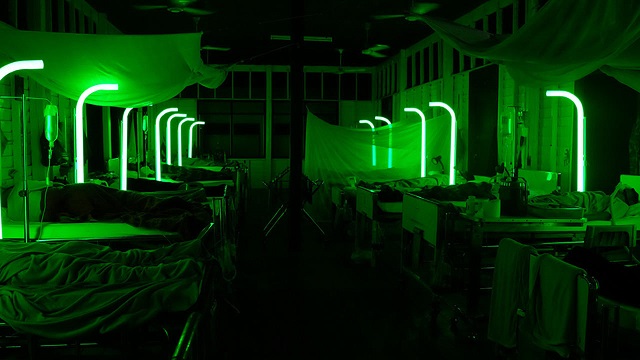
Weerasethakul works like no one else, making unique claims on viewers and, at his best, yielding indelible images like the glowing hospital lights.
The first time I saw Cemetery of Splendor, I like to tell myself that I engaged it exactly as writer/director/necromancer Apichatpong Weerasethakul intended, by which I mean I fell asleep. More than once. Kind of a lot. Now, in my defense, not only is the movie substantially about the act of sleepeven sleep as a portal into alternate states of being and out-of-body experiencebut it was, at 9:30pm, the sixth of six movies I saw that day at the Toronto International Film Festival. (The first, starting at 9:30am, had been Nicolás Pereda's entrancing Minotaur, was also about narcoleptic characters constantly dropping off.) I liked what I saw but also felt, for the first time, a sense of Apichatpong cruising in an Apichatpong lane that, without resembling anyone else's movies in the slightest, was starting to feel familiar. I suspected this reaction was at least half-warranted but also, given the multiple stretches I missed, at least half-unfair.
Revisiting the movie at last, I still don't have the epiphanic reaction that I have to other Apichatpong films, though I do see more originality, even as I see why I might have recognized it as retread. Cemetery of Splendor has perhaps the most serene surface of any of his movies, the least urgency about plot, and the fewest structural gambits, like the midfilm pivots into different stories and registers common to his early films or the crowd-sourced yarn-spinning of Mysterious Object at Noon or the abrupt flirtations with still-montage or creature-feature in Uncle Boonmee. Cemetery of Splendor is just as interested as those films in the porous boundaries between myth, life, and afterlife, between past and present, between the banal and the unknowable, and especially between spirits and bodies, which prove especially detachable and remixable in more than one instance. But Cemetery of Splendor approaches all those preoccupations and metaphysical riddles with an unforced touch, pausing for some gentle humor, some local tourism, some sweet moments of warmth between spouses or among nurses or between doctors and patients. The film rolls itself out like a picnic blanket that just keeps unfurling, in expected and unexpected directions, hoping all the while you'll just lie down and get comfortable. Eyes hopefully open, but maybe it's fine if they're not.
This easygoing tranquility in Cemetery of Splendor stands in ironic contrast to Apichatpong's unusually close approach to political ideas: unavoidable in a film whose male characters are mostly soldiers, and most of them are falling prey to a mysterious catatonia nobody understands. They're being drip-fed in a makeshift clinic inside an elementary school, but we come to understand the ruins of a royal cemetery lie beneath that school; the dead kings interred down there have never stopped clashing, and might even be sapping the spirits of the sleeping soldiers in order to sustain their own endless mêlées.
In other words, if you find yourself in drowsy, placid environs, not only does that not mean things aren't messier and bloodier elsewhere, but the dialectics of peace and war might be even gnarlier than we thought, even/especially in a country peopled with plenty of ghosts (albeit nice, chipper ones) and with a notably snoozy populace. I do remember from Apichatpong's past-midnight Q&A in 2015 that these political ideas in Cemetery of Splendor were quite important to him. He even voiced some bruised feelings about Cannes reviews that had suggested Cemetery wasn't breaking as much new ground as each earlier feature had done, when he was so conscious of taking provocative, even socially critical stands that had certainly been received as such in Thailand.
So, there's plenty to ponder here, even as there are other touch points and textures that stand on their own, away from these broader concernsthe most touching of these, to me, being the return of his longtime actress Jenjira Pongpas, newly compromised by a motorcycle accident that nearly cost her a leg, which becomes more of a plot concern and an undisguised spectacle as the movie continues, leading in turn to an uncommonly touching scene of grief and care. (That scene is also defiantly strange; this is still an Apichatpong joint.)
I might still venture that Cemetery of Splendor needn't be two hours long, when so much that's striking about it comes through well before the credits rolleven as I understand the relations of large to small, quiet to loud, condensation and sprawl to be part of what Cemetery is also "about." A good portion of the final half-hour is taken up by a long, shared walk between Pongpas's character and another figure who, by logics I won't explain, is two people at once, both well-known to us, now collapsed into one body. I didn't find this interlude as rewarding as other mediumistic interludes in the Apichatpong canon, even as it points to a larger, meaningful meditation on a majestic, historical Thailand that now mostly slumbers beneath the tree-trunks and parks and nondescript small-town fixtures of the present.
The moments of bafflement in Cemetery of Splendor are presented less forcefully than in other movies by this artist: no tigers start talking, no one turns into an animal or a cannibal or a red-eyed simian, no one fucks a catfish, etc. But even if the riddles are less pronounced, I think the movie itself is slippery in a new way. It's both a casual hang and an ongoing daisy-chain of mysteries, which only seem more subdued because they're presented so gently. I imagine further viewing experience will keep differing, and that even the title will keep rotating for me: an opulent graveyard, or a scrubby plot where the decaying remains of long-lost magnificence lie buried? On balance, I preferred my fully alert viewing to my half-somnolent one, but with an experience this open to however an audience member might approach or interpret it, you can hardly go wrong. Grade:B